Licensing agency and license types
In Pennsylvania, contract security licensing is handled by County court / district attorney under the Private Detective Act of 1953; Pennsylvania State Police Lethal Weapons Training Program (Act 235) for armed work. Start on the official site: Apply for Act 235 certification (PSP). The snapshot below is a research guide, not a substitute for the agency’s current forms and instructions.
| Company Private Detective / Watch, Guard or Patrol Agency license (county-issued) | Issued under Section 6 of the Private Detective Act of 1953. The applicant or a member of the firm must meet the Act’s experience rule (commonly at least three years in qualifying investigative, detective, sheriff, State Police, or police work above patrolman rank). The licensee must be at least 25. You need a license in each county where you conduct the business — confirm filing instructions with that county’s clerk of courts or district attorney. |
|---|
| Unarmed guards No statewide unarmed guard registration | There is no statewide unarmed guard card. Counties or clients may still set their own hiring or training expectations. Confirm any local rules before you post unarmed officers. |
|---|
| Armed guards Act 235 Lethal Weapons Training certification | Required for armed (“lethal weapons”) work. Applicants apply in the TACS system, complete fingerprints, pass physical, vision, and psychological exams, then attend an Act 235 certified school after PSP approval. Certification is commonly valid five years, with an 8-hour renewal course before expiration — confirm the current term and course length with PSP. |
|---|
County license experience and age
The Act requires the court to be satisfied of the applicant’s good character, competency, and integrity, and it states that no license shall be issued to a person under the age of 25. Qualifying experience is described in the Act (and in our November 18, 2026 research) as regular employment as a detective, U.S. government investigator, sheriff, Pennsylvania State Police member, or city police officer above patrolman rank for at least three years. Confirm how your county applies that experience rule when you file.
Guard cards, armed vs. unarmed, and training
There is no statewide pre-assignment training hour requirement for unarmed guards in the sources we reviewed. That does not mean you can skip training — build a company training program, and check any county or client rules.
Act 235 certification is required. Official PSP materials describe a basic training path after medical, vision, and psychological exams. Our research listed a 40-hour basic course (26 academic and 14 firearms) and an 8-hour renewal course; treat course length as something to confirm with the certified school and PSP, because tuition and schedules are set by the schools.
The county agency license lasts two years under Section 6 of the Act, and renewals require the fee and bond again (plus any current county filing charges). Confirm Act 235 renewal timing with PSP.
Insurance and bond requirements
The Private Detective Act’s statewide financial-responsibility requirement is a $10,000 corporate surety bond, not a statutory general-liability minimum. Clients, landlords, and your own risk management will often require commercial general liability and workers’ compensation anyway. Confirm whether a particular county asks for any additional certificate.
Section 6 of the Private Detective Act of 1953 requires the applicant to file a corporate surety bond in the sum of $10,000, written by a corporate surety authorized in Pennsylvania and approved by the court, conditioned on the faithful and honest conduct of the business. The aggregate liability of the surety is limited to the amount of the bond.
Fees
State application and license fees are only part of what a launch costs. Training-school tuition, fingerprints, insurance or bond premiums, and entity-formation filings are usually extra. Confirm every figure with the agency before you pay.
| County agency license fee — individual (statutory) | $200 Section 6 of the Act, paid for the use of the county, for a two-year license. |
|---|
| County agency license fee — partnership, association, or corporation (statutory) | $300 Same statutory section and two-year term. |
|---|
| County clerk or court filing or processing charges | Varies by county These are in addition to the statutory license fee. Confirm with the clerk of courts or district attorney in each county where you will operate. |
|---|
| Act 235 application + fingerprint + certification fees | $104.95 Official PSP breakdown: $50 application (TACS), $24.95 fingerprint fee to MorphoTrust/IdentoGO, and $30 certification fee after training. School tuition and medical, vision, and psychological exams are extra and paid by the applicant. |
|---|
Statutory license fees and the $10,000 bond come from the official text of the Act. County add-on charges vary. Act 235 state fees are from the official PSP application page. Do not treat school tuition as a state fee.
Steps and timeline
- Decide which counties you will operate in. You need a license in each county where you conduct the watch, guard, or patrol business. Start with your home county and get that clerk’s current packet.
- Document qualifying experience and meet the age rule. The qualifying individual must be at least 25 and able to show the Act’s experience and character requirements.
- Obtain the $10,000 corporate surety bond. Have it executed to the Commonwealth and ready for the clerk of court to file.
- File the county application. Pay the statutory fee plus any county charges, and wait the statutory ten-day period and any additional investigation the court or district attorney requires.
- If you will work armed, complete Act 235. Apply in TACS ($50), get fingerprinted, complete the medical exams, wait for PSP approval, attend a certified school, then pay the $30 certification fee.
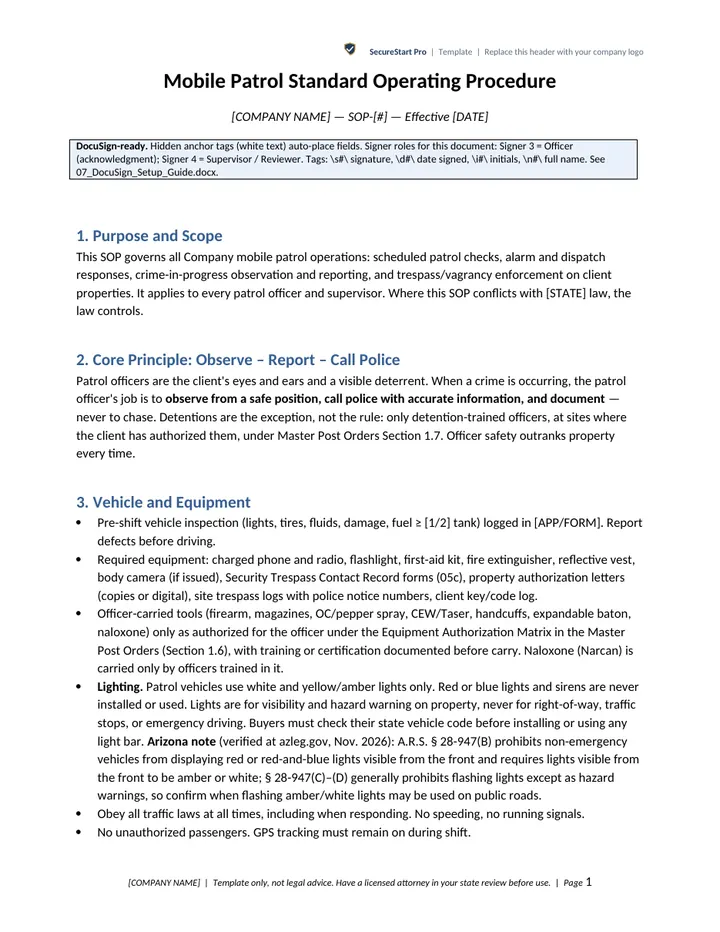
- Set up operations and sell patrol accounts. Without a statewide unarmed card system, your contracts, training records, post orders, and patrol SOPs are what make the company look professional to clients and to the court.
The Act requires a period of ten days from the filing date before the court issues a license, plus whatever further inquiry the court or district attorney makes. Actual county timing varies. Act 235 adds time for fingerprints, medical exams, PSP approval, and school scheduling. The county license then lasts two years.
The Pennsylvania Edition’s Action Workbook turns this sequence into a checklist, with the State Supplement and sources beside it. See what’s in the Pennsylvania kit or buy the Pennsylvania Edition for $299.
License types and training hours were first compiled for the Pennsylvania Edition on 2026-11-18. Fees, insurance, and bond figures were checked against official sources on 2026-11-22. Laws change; if a number here disagrees with the agency, the agency is right.