Licensing guide · New York

How to Start a Security Guard Company in New York

New York licenses the company and the guards separately. The Department of State, Division of Licensing Services, issues the Watch, Guard or Patrol Agency license (General Business Law Article 7) and Security Guard Registration Cards (Article 7-A, the Security Guard Act). Training curricula are overseen with the Division of Criminal Justice Services. If you employ security guards, you also have to carry specified liability insurance.

Official agency: New York Department of State, Division of Licensing Services

Get the New York Edition · $299See the New York kit page

Licensing agency and license types

In New York, contract security licensing is handled by New York Department of State, Division of Licensing Services. Start on the official site: Get a Watch, Guard or Patrol Agency license. The snapshot below is a research guide, not a substitute for the agency’s current forms and instructions.

Company
Watch, Guard or Patrol Agency license
The company license to operate a contract watch, guard, or patrol business. It is issued for two years. The qualifying principal must be at least 25, pass the agency exam, and meet the experience rule.
Unarmed guards
Security Guard Registration Card
Statewide registration, typically for two years, after required training.
Armed guards
Special Armed Guard Registration Card
Required for armed work, in addition to a New York pistol license. Initial firearms training is commonly 47 hours, plus an 8-hour annual firearms in-service course.

Agency qualifying experience and exam

The Department of State requires the applicant (a principal in the business) to be at least 25, to pass the Watch, Guard or Patrol examination within the two years before the application, and to have either two years’ experience or two years in an equivalent position. General Business Law § 72 describes qualifying experience as regular employment for not less than two years performing watch, guard, or patrol agency duties, or service as a sheriff, police officer, or similar qualifying work.

Guard cards, armed vs. unarmed, and training

Unarmed guards complete 8 hours of pre-assignment training, then 16 to 40 hours of on-the-job training within 90 working days of employment, plus 8 hours of annual in-service training.

Armed guards need the Special Armed Guard Registration Card and a New York pistol license. Initial firearms training is commonly 47 hours, with an additional 8-hour annual in-service firearms course.

Agency licenses and guard registrations typically renew every two years. Required training must be on file before renewal. A registration expired for six months or more generally requires reapplication.

Insurance and bond requirements

If the agency employs security guards, the Department of State requires evidence of liability insurance of at least $100,000 per occurrence and $300,000 in the aggregate, and a statement that coverage includes false arrest or false imprisonment, malicious prosecution, libel, slander, and violation of the right to privacy.

Applicants must file a $10,000 surety company bond, as stated on the official Department of State agency-license page and in General Business Law § 74.

Fees

State application and license fees are only part of what a launch costs. Training-school tuition, fingerprints, insurance or bond premiums, and entity-formation filings are usually extra. Confirm every figure with the agency before you pay.

Watch, Guard or Patrol Agency license — individual (initial, branch, or renewal)$300
Watch, Guard or Patrol Agency license — corporate or business (initial, branch, or renewal)$400
Written exam$15
Fingerprinting, support staff / employee statement (payable to IDEMIA)$88.50
Listed on the agency-license page. Guard fingerprinting is listed separately as $102.50.
Security Guard registration, initial / renewal$36 / $25
Plus $102.50 fingerprint fee (payable to IDEMIA) on a new registration.

Amounts are from the official Department of State pages. Application fees are nonrefundable. Training-school tuition and insurance or bond premiums are extra.

Steps and timeline

  1. Form the business. Organize the entity and make sure a principal who is at least 25 can qualify and sit for the exam.
  2. Pass the Watch, Guard or Patrol exam. The exam has to be passed within the two years immediately before you apply. DOS posts exam schedules on the agency-license page.
  3. Obtain the $10,000 surety bond and, if you will employ guards, the required liability policy. Use the DOS bond form and make sure the liability certificate includes the specified coverages.
  4. Fingerprint and file the agency application. Submit the application, fees, fingerprints, bond, and insurance to the Division of Licensing Services.
  5. Register every guard. Complete required training and file each Security Guard Registration (and the special armed card if applicable) before the person works as a security guard.
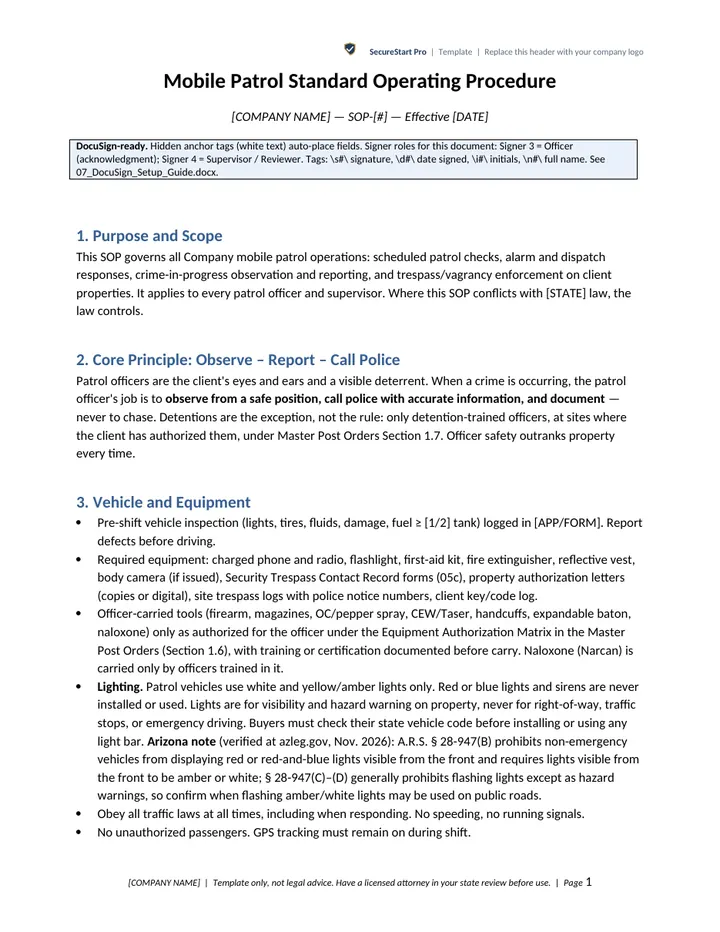
  6. Put operations and sales in place. Contracts, post orders, patrol SOPs, and a pricing model should be ready when you start calling property managers and bid portals.

DOS does not publish a single guaranteed processing time. The exam schedule, fingerprints, and bond or insurance paperwork usually drive the calendar. Licenses typically run two years. Confirm current turnaround with the Division of Licensing Services.

The New York Edition’s Action Workbook turns this sequence into a checklist, with the State Supplement and sources beside it. See what’s in the New York kit or buy the New York Edition for $299.

License types and training hours were first compiled for the New York Edition on 2026-11-18. Fees, insurance, and bond figures were checked against official sources on 2026-11-22. Laws change; if a number here disagrees with the agency, the agency is right.
Avoid the first-year mistakes

Most new security companies learn these the expensive way.

Starting without a plan usually means learning by losing: a bid that didn’t cover costs, a contract that didn’t protect you, a license that took longer than it should have. SecureStart Pro puts the plan and the paperwork in place before those mistakes happen.

Mistake 01

Underpricing your first bids

Quoting a rate that looks competitive but doesn’t cover payroll taxes, insurance, overtime, and supervision, then working a contract at a loss.

How the kit fixes it

Pay & Pricing Report + Bid Pricing Calculator

Enter your real costs and get bill rates, minimum rates, and monthly contract values before you quote.

Mistake 02

Signing clients on a weak contract

Starting work on a handshake or a one-page quote, with no clear scope, payment terms, or limits on your liability.

How the kit fixes it

Client Security Services Agreement

A full client contract, DocuSign-ready, for your attorney to review and your logo to go on.

Mistake 03

Losing months to licensing

Applying for the wrong license, missing a training requirement, or not knowing which agency to call, and waiting while you can’t legally take a post.

How the kit fixes it

State Supplement + Action Workbook

Your state’s regulator, license names, and training rules in one place, with a step-by-step checklist from licensing on.

Mistake 04

Officers with no written post orders

Guards guessing what the client wants, and the client finding out the hard way after something goes wrong.

How the kit fixes it

Master Post Orders + Patrol & Trespass SOPs

Written post orders with site addenda, plus mobile patrol and trespass enforcement procedures.

Mistake 05

No reports to show the client

Nothing in writing about what happened on shift, so the client can’t see the value and an incident turns into your word against theirs.

How the kit fixes it

Daily Activity & Incident Reports

Professional reports your officers fill out every shift, ready to send to the client.

Mistake 06

Letting a guard license lapse

Losing track of who is licensed, certified, and due to renew, and putting an unlicensed officer on a post.

How the kit fixes it

Guard License Tracker + New Hire Packet

Track every officer’s license and certifications, and onboard new hires the same way every time.

Mistake 07

Waiting for clients to find you

No marketing system: no target list, no outreach, no follow-up, and a slow first year.

How the kit fixes it

Marketing Plan + Client-Acquisition Playbook

Target metros, where to bid, and how to win your first clients. Add the Marketing Pack for ready-made flyers, letters, emails, and videos.

Mistake 08

Only selling standing posts

Building the whole company on one-officer-one-site posts and never offering mobile patrol, the service that lets one officer cover many clients.

How the kit fixes it

Mobile Patrol SOP + Bid Calculator

Run patrol routes the right way and price per-visit patrol accounts so they stay profitable.

Start with the plan →
The mobile patrol advantage

In our experience, mobile patrol runs about 60% more profitable than standing posts.

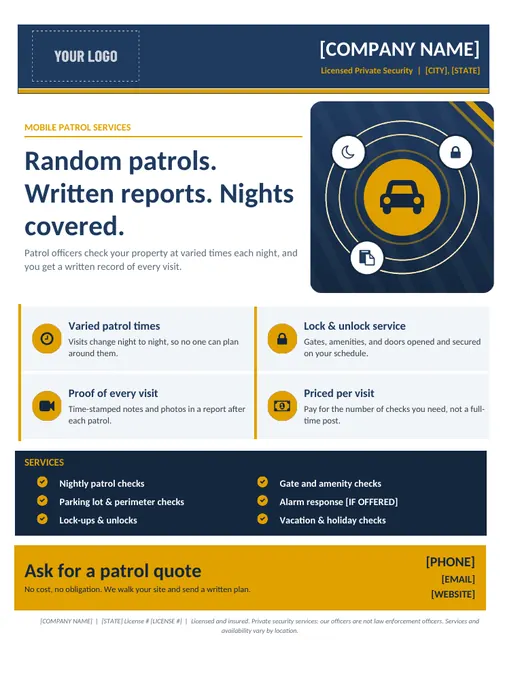
A standing post puts one officer at one site for the whole shift. A patrol officer in a vehicle can check several client sites in the same shift: apartment complexes, HOAs, construction sites, vacant buildings, business parks. More clients share the cost of one officer and one vehicle, and that’s where the margin comes from.

Treestone’s results; your results will vary depending on your market, effort and execution. Not a guarantee of earnings.

The New York Edition includes a Mobile Patrol SOP, trespass paperwork, a bid calculator you can use to price routes, and a marketing playbook for finding patrol clients. The Marketing Pack adds patrol flyers, letters, and a short “2 AM patrol” video.

FAQ

Questions about starting in New York

What is a Watch, Guard or Patrol Agency license?

It is New York’s company license for a contract guard or patrol business, issued by the Department of State for two years.

Is a surety bond required?

Yes. Official DOS materials require a $10,000 surety bond. If you employ security guards, you also need liability insurance of at least $100,000 per occurrence and $300,000 aggregate with the specified coverages.

How old do I have to be to get the agency license?

The official DOS requirements list a minimum age of 25 for the qualifying principal.

Do I also need a security guard registration if I own the company?

If you personally perform security-guard work, registration rules can still apply. Confirm with DOS. Employees who work as security guards must be registered.

What is in the SecureStart Pro New York Edition?

22 editable files for $299, including New York-specific research, an action workbook, pricing tools, contracts, and SOPs. Templates, not legal advice.

Please read: SecureStart Pro provides business templates and educational materials, not legal advice. Laws and licensing rules differ by state and change over time; confirm every requirement with your state's licensing agency and have a licensed attorney in your state review the contracts and policies before use. We do not guarantee licensing, contracts, or revenue. Official rules always control. Full disclaimer & terms.

Free download

The First-Year Mistakes Checklist.

Eight mistakes that stall new guard companies — underpricing, weak contracts, licensing delays, and only selling standing posts — plus how to avoid them and why mobile patrol can change the math. Enter your name, email, and state and get the PDF.

We use your name, email, and state to send this checklist and occasional emails about SecureStart Pro. We don’t sell your information. You can ask us to stop or delete your details anytime through our Payhip store. Privacy note.

Get the New York kit, or pick another state.

22 editable files, written for New York, $299. Or browse the other licensing guides.

Buy the New York EditionAll guides
New York Edition22 editable files · $299
Buy now