Licensing guide · New Jersey

How to Start a Security Guard Company in New Jersey

New Jersey regulates contract security work through two official State Police programs that are easy to confuse. Individual security officers are registered under the Security Officer Registration Act (SORA), administered by the New Jersey State Police. Operating a security company is generally tied to the Private Detective license framework also administered by NJSP under N.J.S.A. 45:19. Use the official NJSP Private Detective and SORA materials for the current applications; do not treat an officer’s SORA certificate as a company license.

Official agency: New Jersey State Police — Private Detective Unit and SORA (Security Officer Registration Act) program

Get the New Jersey Edition · $299See the New Jersey kit page

Licensing agency and license types

In New Jersey, contract security licensing is handled by New Jersey State Police — Private Detective Unit and SORA (Security Officer Registration Act) program. Start on the official site: NJSP SORA FAQ (confirm current applications with the Private Detective / SORA unit). The snapshot below is a research guide, not a substitute for the agency’s current forms and instructions.

Company
Private Detective (agency) license, as it applies to a security company
New Jersey’s company-level credential for this industry is administered by the State Police Private Detective Unit. Confirm on the current official application whether the work you will sell requires that license. Do not start advertising contract security work until NJSP has told you which company credential applies and you have it in hand.
Qualifying manager
Qualifying licensee / officer of the firm
The official Private Detective application sets experience, character, and examination or waiver rules for the person who qualifies the firm. Use that packet, not a third-party summary, for the current requirements.
Unarmed guards
SORA certificate of registration
Security officers must be registered under the Security Officer Registration Act unless an official exemption applies (official materials discuss exemptions such as certain loss-prevention roles — confirm those exemptions on the current SORA FAQ). SORA registration is an individual credential, not a company license.
Armed guards
Armed work as SORA, NJSP, and New Jersey firearm law require
Confirm with NJSP whether additional firearms training, permits, or endorsements are required before a registered officer is armed on duty.

Qualifying person for the company credential

Use the official NJSP Private Detective application instructions for the current experience, examination, and character rules. This guide does not invent a year-count that should be read from the current packet.

Guard cards, armed vs. unarmed, and training

Most contract security officers need a SORA certificate of registration, plus the official training SORA requires. Official FAQs have listed application and renewal fees, but some posted PDFs are older; confirm the current dollar amounts and training hours with NJSP before you pay or schedule a class.

Confirm firearms rules with NJSP and New Jersey firearm statutes before an officer is armed.

SORA registration and any company credential have their own renewal cycles. Confirm current terms and fees with NJSP; do not rely on an outdated FAQ PDF.

Insurance and bond requirements

Company licensing requires the insurance the official Private Detective packet specifies. Confirm the current types and dollar minimums on that packet before you bind a policy.

Confirm the current surety-bond requirement and amount on the official Private Detective application. This guide does not reprint a figure from an unverified secondary chart.

Fees

State application and license fees are only part of what a launch costs. Training-school tuition, fingerprints, insurance or bond premiums, and entity-formation filings are usually extra. Confirm every figure with the agency before you pay.

We could not confirm official fee amounts for publication in this guide. Use the agency’s current fee schedule, linked below, before you pay or apply.

Official NJSP pages and PDFs do list SORA and Private Detective fees, but some widely circulated PDFs are several years old. Because a stale fee can be wrong, this guide does not reprint those dollar amounts. Use the current official application or contact the Private Detective / SORA unit before you pay. Training, fingerprints, and insurance or bond premiums are extra.

Steps and timeline

  1. Contact the NJSP Private Detective / SORA unit and download the current official packets. Confirm whether your company needs a Private Detective license before you advertise or post officers.
  2. Qualify the person who will hold the company credential. Follow the official experience and application rules in the current packet.
  3. Obtain the required insurance or bond. Match the legal name to the official application.
  4. File the company application with NJSP. Pay only the amounts on the current official form.
  5. Register each officer under SORA. Complete official SORA training and the current application, and confirm fees with NJSP.
  6. Launch operations and sell patrol as well as standing posts. Contracts, post orders, patrol SOPs, and a bid calculator should be ready when you start calling property managers.

NJSP does not publish a single guaranteed processing time on the materials we reviewed. Fingerprints, SORA training, and the company-license review usually drive the calendar. Confirm current turnaround with the unit when you file.

The New Jersey Edition’s Action Workbook turns this sequence into a checklist, with the State Supplement and sources beside it. See what’s in the New Jersey kit or buy the New Jersey Edition for $299.

License types and training hours were first compiled for the New Jersey Edition on 2026-11-18. Fees, insurance, and bond figures were checked against official sources on 2026-11-22. Laws change; if a number here disagrees with the agency, the agency is right.
Avoid the first-year mistakes

Most new security companies learn these the expensive way.

Starting without a plan usually means learning by losing: a bid that didn’t cover costs, a contract that didn’t protect you, a license that took longer than it should have. SecureStart Pro puts the plan and the paperwork in place before those mistakes happen.

Mistake 01

Underpricing your first bids

Quoting a rate that looks competitive but doesn’t cover payroll taxes, insurance, overtime, and supervision, then working a contract at a loss.

How the kit fixes it

Pay & Pricing Report + Bid Pricing Calculator

Enter your real costs and get bill rates, minimum rates, and monthly contract values before you quote.

Mistake 02

Signing clients on a weak contract

Starting work on a handshake or a one-page quote, with no clear scope, payment terms, or limits on your liability.

How the kit fixes it

Client Security Services Agreement

A full client contract, DocuSign-ready, for your attorney to review and your logo to go on.

Mistake 03

Losing months to licensing

Applying for the wrong license, missing a training requirement, or not knowing which agency to call, and waiting while you can’t legally take a post.

How the kit fixes it

State Supplement + Action Workbook

Your state’s regulator, license names, and training rules in one place, with a step-by-step checklist from licensing on.

Mistake 04

Officers with no written post orders

Guards guessing what the client wants, and the client finding out the hard way after something goes wrong.

How the kit fixes it

Master Post Orders + Patrol & Trespass SOPs

Written post orders with site addenda, plus mobile patrol and trespass enforcement procedures.

Mistake 05

No reports to show the client

Nothing in writing about what happened on shift, so the client can’t see the value and an incident turns into your word against theirs.

How the kit fixes it

Daily Activity & Incident Reports

Professional reports your officers fill out every shift, ready to send to the client.

Mistake 06

Letting a guard license lapse

Losing track of who is licensed, certified, and due to renew, and putting an unlicensed officer on a post.

How the kit fixes it

Guard License Tracker + New Hire Packet

Track every officer’s license and certifications, and onboard new hires the same way every time.

Mistake 07

Waiting for clients to find you

No marketing system: no target list, no outreach, no follow-up, and a slow first year.

How the kit fixes it

Marketing Plan + Client-Acquisition Playbook

Target metros, where to bid, and how to win your first clients. Add the Marketing Pack for ready-made flyers, letters, emails, and videos.

Mistake 08

Only selling standing posts

Building the whole company on one-officer-one-site posts and never offering mobile patrol, the service that lets one officer cover many clients.

How the kit fixes it

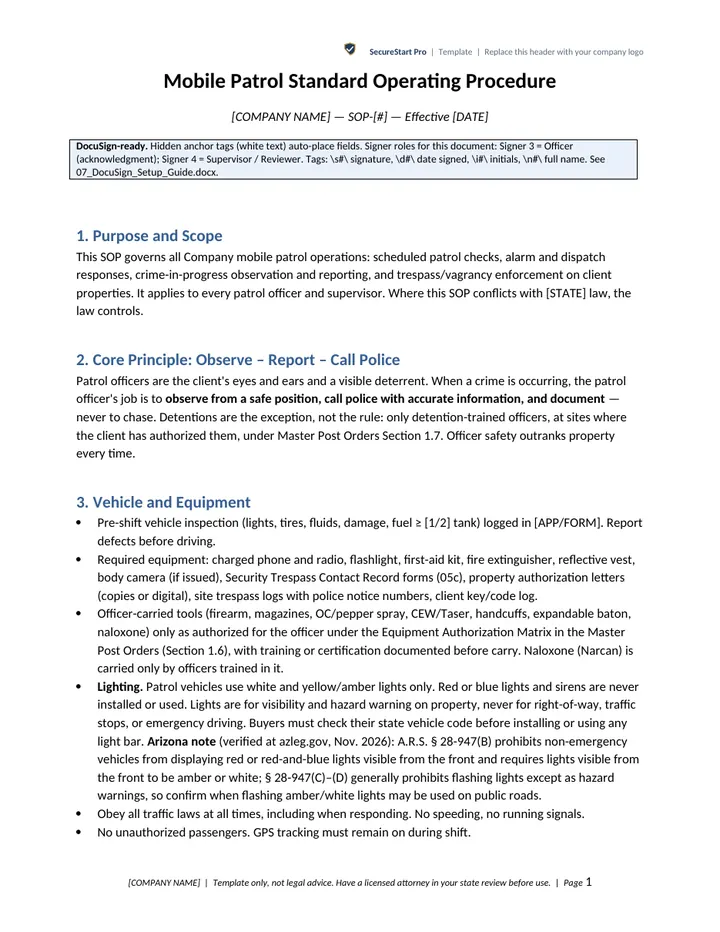
Mobile Patrol SOP + Bid Calculator

Run patrol routes the right way and price per-visit patrol accounts so they stay profitable.

Start with the plan →
The mobile patrol advantage

In our experience, mobile patrol runs about 60% more profitable than standing posts.

A standing post puts one officer at one site for the whole shift. A patrol officer in a vehicle can check several client sites in the same shift: apartment complexes, HOAs, construction sites, vacant buildings, business parks. More clients share the cost of one officer and one vehicle, and that’s where the margin comes from.

Treestone’s results; your results will vary depending on your market, effort and execution. Not a guarantee of earnings.

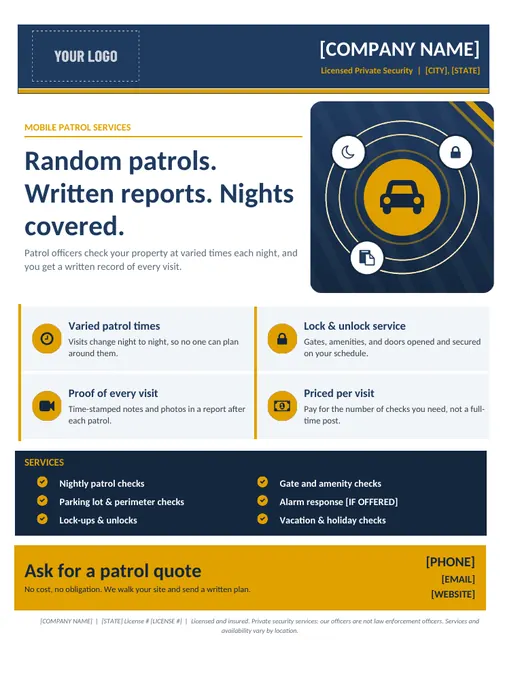
The New Jersey Edition includes a Mobile Patrol SOP, trespass paperwork, a bid calculator you can use to price routes, and a marketing playbook for finding patrol clients. The Marketing Pack adds patrol flyers, letters, and a short “2 AM patrol” video.

FAQ

Questions about starting in New Jersey

What license does a New Jersey guard company need?

Typically a company credential administered by the NJSP Private Detective Unit, plus a SORA registration for each security officer. Confirm the current company credential on the official application before you operate.

Is a SORA card enough to open a company?

No. SORA registers individual officers. The company credential is a separate NJSP process.

Where are the fees?

On the current official NJSP applications. This guide does not reprint amounts from older posted PDFs.

Are there SORA exemptions?

Official SORA materials discuss limited exemptions (including certain loss-prevention roles). Confirm any exemption with the current official FAQ before you rely on it.

What is in the SecureStart Pro New Jersey Edition?

22 editable files for $299, including New Jersey research, an action workbook, pricing tools, contracts, and SOPs. Templates, not legal advice.

Please read: SecureStart Pro provides business templates and educational materials, not legal advice. Laws and licensing rules differ by state and change over time; confirm every requirement with your state's licensing agency and have a licensed attorney in your state review the contracts and policies before use. We do not guarantee licensing, contracts, or revenue. Official rules always control. Full disclaimer & terms.

Free download

The First-Year Mistakes Checklist.

Eight mistakes that stall new guard companies — underpricing, weak contracts, licensing delays, and only selling standing posts — plus how to avoid them and why mobile patrol can change the math. Enter your name, email, and state and get the PDF.

We use your name, email, and state to send this checklist and occasional emails about SecureStart Pro. We don’t sell your information. You can ask us to stop or delete your details anytime through our Payhip store. Privacy note.

Get the New Jersey kit, or pick another state.

22 editable files, written for New Jersey, $299. Or browse the other licensing guides.

Buy the New Jersey EditionAll guides
New Jersey Edition22 editable files · $299
Buy now