Licensing guide · District of Columbia

How to Start a Security Guard Company in the District of Columbia

The District of Columbia licenses security agencies, security officers, special police officers, and related credentials through the Department of Licensing and Consumer Protection (DLCP) Occupational and Professional Licensing Security Program, with fingerprinting and certain sign-offs still involving the Metropolitan Police Department Security Officers Management Branch (SOMB). Rules are in the D.C. security licensing laws and DCMR Title 17.

Official agency: D.C. Department of Licensing and Consumer Protection (DLCP) — Occupational and Professional Licensing Security Program

Get the District of Columbia Edition · $299See the District of Columbia kit page

Licensing agency and license types

In the District of Columbia, contract security licensing is handled by D.C. Department of Licensing and Consumer Protection (DLCP) — Occupational and Professional Licensing Security Program. Start on the official site: DLCP Security Program (applications and fee schedule). The snapshot below is a research guide, not a substitute for the agency’s current forms and instructions.

Company
Security Agency Business (SAB) or Security Agency Individual (SAI) license
Required to operate a security agency in the District. Official DLCP materials distinguish a Security Agency Business license from a Security Agency Individual (business) license, and also list a campus/university agency category. New applications require notarized affidavits, fingerprinting scheduled with MPD, and the published application fee.
Qualifying manager
Designated responsible person / agency individual
Entity applications are filed by a person who can bind the company and who completes the individual documentation DLCP requires. Confirm the current designated-representative or experience rule in the official new-application checklist.
Unarmed guards
Security Officer (SO) license
Security officers are licensed by DLCP. Official materials list a new-application fee and a separate exam fee paid to the PSI testing center. Special Police Officers (SPO) and Special University/Campus Police are separate credentials with arrest-type authority that SO status does not confer.
Armed guards
Special Police Officer (SPO), where needed; firearms rules as DLCP and MPD require
Armed or special-police work uses different credentials than a standard security officer license. Firearms-instructor licensing remains with MPD SOMB on the official SOMB fee table. Confirm current armed-SO or SPO firearm rules with DLCP and MPD before anyone is armed.

Agency applicant and required filings

Official DLCP agency applications require notarized arrest-affidavit and release forms, MPD fingerprints scheduled in advance, and the documents listed for SAB or SAI. Confirm any experience or qualifying-officer rule on the current checklist rather than assuming a year-count from a secondary source.

Guard cards, armed vs. unarmed, and training

Security officers apply through DLCP, complete fingerprinting with MPD, and pay the official application fee plus the PSI exam fee listed on the Security Program page. Confirm current training or exam content with DLCP and PSI.

Do not treat an SO license as permission to work armed or as a special police officer. SPO and related credentials have their own applications and fees on the official DLCP page. Firearms instructors are licensed by MPD SOMB.

Official DLCP materials list renewal fees for agency, officer, and SPO credentials. Confirm the current term length and any in-service training with DLCP; the pages we reviewed listed fees but not a single term in years for every credential.

Insurance and bond requirements

Agency applications require the insurance DLCP and District rules specify. Confirm the current types and dollar minimums on the official new-application document list and in DCMR before you bind a policy. The certificate should match the agency’s legal name.

Confirm with DLCP whether a surety bond is required in addition to liability insurance for your agency type. This guide does not list a bond amount because we did not confirm one on the official fee page.

Fees

State application and license fees are only part of what a launch costs. Training-school tuition, fingerprints, insurance or bond premiums, and entity-formation filings are usually extra. Confirm every figure with the agency before you pay.

Security Agency Business (SAB) — new$1,000
Official DLCP Security Program page.
Security Agency Business — renewal$935
Same official page.
Security Agency Individual (SAI) — new$500
Same official page.
Security Agency Individual — renewal$435
Same official page.
Security Officer — new or renewal$103
New applications also list a $69 exam fee paid directly to the PSI testing center.
Special Police Officer or Special University/Campus Police — new or renewal$84
Official DLCP Security Program page.

Figures are from the official DLCP Security Program page. Fingerprinting is scheduled with MPD and is extra. Training and PSI exam charges are extra. Confirm the page before you pay; District fees can be updated without a separate statute change.

Steps and timeline

  1. Form the entity and gather notarized affidavits. Complete the arrest affidavit and authorization-to-release forms DLCP lists, and watch the document expiration dates on the official page.
  2. Schedule MPD fingerprints before you submit. DLCP directs applicants to schedule fingerprints with MPD first. Questions can go to the SOMB admin email listed on the official page.
  3. Obtain the required insurance. Match the agency’s legal name and upload the certificate with the application.
  4. Apply for the SAB or SAI license and pay the official fee. $1,000 for a new Security Agency Business license or $500 for a new Security Agency Individual license, per DLCP.
  5. License each officer. Security officers pay $103 plus the $69 PSI exam fee; SPO credentials, if needed, are a separate $84 application.
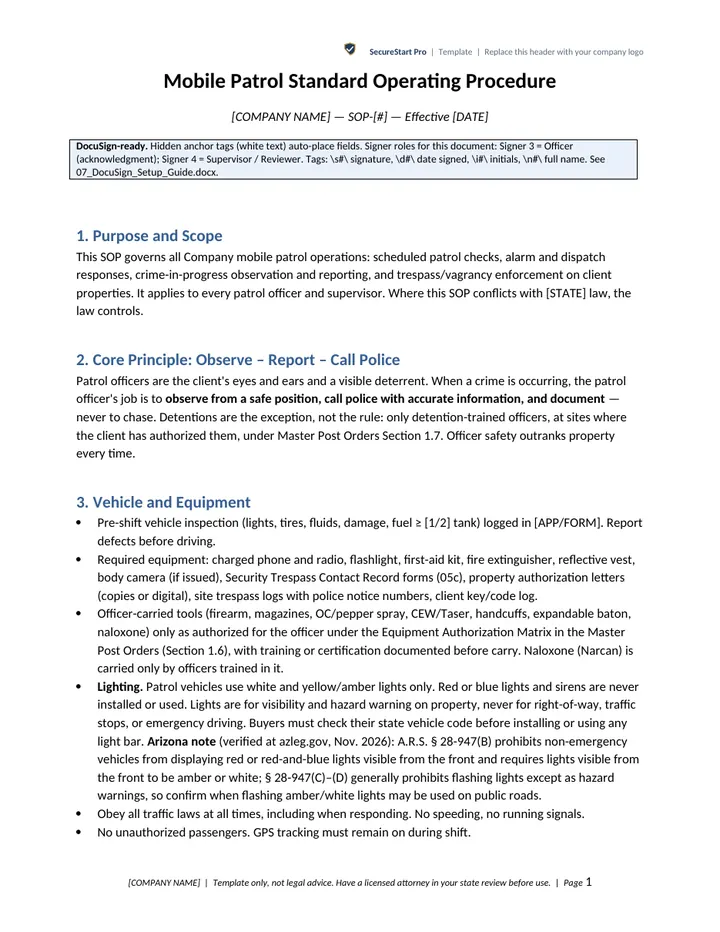
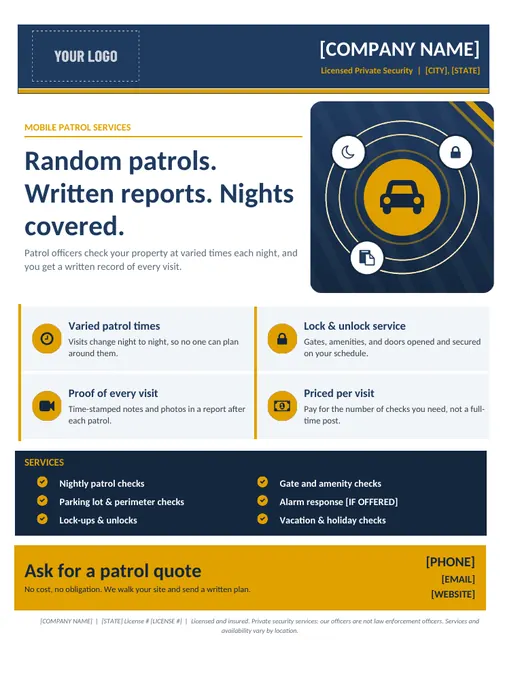
  6. Launch operations and sell patrol as well as standing posts. Contracts, post orders, patrol SOPs, and a bid calculator should be ready when you start calling property managers in the District.

DLCP does not publish a single guaranteed processing time on the Security Program page we reviewed. Fingerprints, the PSI exam, and document completeness usually drive the calendar. Confirm current turnaround with DLCP when you apply.

The District of Columbia Edition’s Action Workbook turns this sequence into a checklist, with the State Supplement and sources beside it. See what’s in the District of Columbia kit or buy the District of Columbia Edition for $299.

License types and training hours were first compiled for the District of Columbia Edition on 2026-11-18. Fees, insurance, and bond figures were checked against official sources on 2026-11-22. Laws change; if a number here disagrees with the agency, the agency is right.
Avoid the first-year mistakes

Most new security companies learn these the expensive way.

Starting without a plan usually means learning by losing: a bid that didn’t cover costs, a contract that didn’t protect you, a license that took longer than it should have. SecureStart Pro puts the plan and the paperwork in place before those mistakes happen.

Mistake 01

Underpricing your first bids

Quoting a rate that looks competitive but doesn’t cover payroll taxes, insurance, overtime, and supervision, then working a contract at a loss.

How the kit fixes it

Pay & Pricing Report + Bid Pricing Calculator

Enter your real costs and get bill rates, minimum rates, and monthly contract values before you quote.

Mistake 02

Signing clients on a weak contract

Starting work on a handshake or a one-page quote, with no clear scope, payment terms, or limits on your liability.

How the kit fixes it

Client Security Services Agreement

A full client contract, DocuSign-ready, for your attorney to review and your logo to go on.

Mistake 03

Losing months to licensing

Applying for the wrong license, missing a training requirement, or not knowing which agency to call, and waiting while you can’t legally take a post.

How the kit fixes it

State Supplement + Action Workbook

Your state’s regulator, license names, and training rules in one place, with a step-by-step checklist from licensing on.

Mistake 04

Officers with no written post orders

Guards guessing what the client wants, and the client finding out the hard way after something goes wrong.

How the kit fixes it

Master Post Orders + Patrol & Trespass SOPs

Written post orders with site addenda, plus mobile patrol and trespass enforcement procedures.

Mistake 05

No reports to show the client

Nothing in writing about what happened on shift, so the client can’t see the value and an incident turns into your word against theirs.

How the kit fixes it

Daily Activity & Incident Reports

Professional reports your officers fill out every shift, ready to send to the client.

Mistake 06

Letting a guard license lapse

Losing track of who is licensed, certified, and due to renew, and putting an unlicensed officer on a post.

How the kit fixes it

Guard License Tracker + New Hire Packet

Track every officer’s license and certifications, and onboard new hires the same way every time.

Mistake 07

Waiting for clients to find you

No marketing system: no target list, no outreach, no follow-up, and a slow first year.

How the kit fixes it

Marketing Plan + Client-Acquisition Playbook

Target metros, where to bid, and how to win your first clients. Add the Marketing Pack for ready-made flyers, letters, emails, and videos.

Mistake 08

Only selling standing posts

Building the whole company on one-officer-one-site posts and never offering mobile patrol, the service that lets one officer cover many clients.

How the kit fixes it

Mobile Patrol SOP + Bid Calculator

Run patrol routes the right way and price per-visit patrol accounts so they stay profitable.

Start with the plan →
The mobile patrol advantage

In our experience, mobile patrol runs about 60% more profitable than standing posts.

A standing post puts one officer at one site for the whole shift. A patrol officer in a vehicle can check several client sites in the same shift: apartment complexes, HOAs, construction sites, vacant buildings, business parks. More clients share the cost of one officer and one vehicle, and that’s where the margin comes from.

Treestone’s results; your results will vary depending on your market, effort and execution. Not a guarantee of earnings.

The District of Columbia Edition includes a Mobile Patrol SOP, trespass paperwork, a bid calculator you can use to price routes, and a marketing playbook for finding patrol clients. The Marketing Pack adds patrol flyers, letters, and a short “2 AM patrol” video.

FAQ

Questions about starting in the District of Columbia

Who licenses guard companies in D.C.?

The Department of Licensing and Consumer Protection Security Program, with fingerprinting through MPD’s Security Officers Management Branch.

How much is the agency license?

Official DLCP materials list $1,000 new / $935 renewal for a Security Agency Business, and $500 new / $435 renewal for a Security Agency Individual.

What does a security officer pay?

$103 for the license application, plus a $69 exam fee paid to PSI for new officers, according to the official page.

Is a Special Police Officer the same as a security officer?

No. SPO is a separate credential with different authority and a different official fee ($84).

What is in the SecureStart Pro District of Columbia Edition?

22 editable files for $299, including D.C. research, an action workbook, pricing tools, contracts, and SOPs. Templates, not legal advice.

Please read: SecureStart Pro provides business templates and educational materials, not legal advice. Laws and licensing rules differ by state and change over time; confirm every requirement with your state's licensing agency and have a licensed attorney in your state review the contracts and policies before use. We do not guarantee licensing, contracts, or revenue. Official rules always control. Full disclaimer & terms.

Free download

The First-Year Mistakes Checklist.

Eight mistakes that stall new guard companies — underpricing, weak contracts, licensing delays, and only selling standing posts — plus how to avoid them and why mobile patrol can change the math. Enter your name, email, and state and get the PDF.

We use your name, email, and state to send this checklist and occasional emails about SecureStart Pro. We don’t sell your information. You can ask us to stop or delete your details anytime through our Payhip store. Privacy note.

Get the District of Columbia kit, or pick another state.

22 editable files, written for the District of Columbia, $299. Or browse the other licensing guides.

Buy the District of Columbia EditionAll guides
District of Columbia Edition22 editable files · $299
Buy now